Friday, September 14, 2018

Bristles and Brushes- The Work of the Chimney Sweep

Family life in every Victorian home centers around the flickering, crackling fireplace but, the warmth and cheery light of the hearth requires filthy and dangerous work to keep it lit. For the next few weeks, we’re going to examine the humble vocation of the Chimney Sweep and their possible uses at the gaming table

New safety regulations after the Great Fire of London reduced the lawful width of a chimney’s interior down to 14 inches. The change from wood to coal as fuel for the fire increased the speed of soot accumulation in the now narrowed chimney flues. Coal fires covered the flue in creosote, and the inevitable soot stuck to the creosote forming thick deposits which could perfectly plug up the chimney if left to accumulate long enough. A clogged flue prevents fresh air from passing over the flames causing a weak fire in the hearth and the stray soot floats into the room blackening any surface it touches. Worse, with no escape up the chimney, smoke and carbon monoxide fills the air around the fireplace. An upward flying spark could ignite the accumulation of creosote in a flue causing the entire chimney to catch fire!

To prevent these disasters, every home relies on chimney sweeps to clean their flue free of soot and clogs. The sweep comes early in the morning when the chimneys are cool and unused. He walks down the street calling “Swe-ep, Swe-ep”, carrying his soot-stained bristles, brushes, and long sections of hollow rods made of flexible cane reeds.  Using these rods he extends his bristles to the top of the highest chimneys. His clothes and skin are black with soot from the top of his cap to his shoes. The room around the hearth has been prepared for his messy profession by the removal of all knickknacks, carpets, and valuables. Sheets cover all furniture and mirrors. A roll of cheap fabric, such as drugget (a coarse woolen fabric) forms a walkway to protect the floor from sooty footprints.

Once his bristles burst out of the chimney pot on the roof, the flue is clear. Depending on the height, a sweep could charge anywhere from 6p for the chimney of a small cottage, or up to three shillings for a very tall complex chimney with multiple hearths. Many sweeps offer an 11 shilling subscription to service a home’s chimneys for a year.  Chimney Sweeps make further income by collecting and selling the soot and ash they scrape free of the flue. The thick tarry mixture can be used for fertilizer, wood preservatives, pest control, and a number of pharmacological applications.  A bushel of chimney scrapings sells for 10p up to a whole shilling. Should a chimney fire ignite, the emergency extinguishing by a sweep called to the home deserves a gift of 5 shillings in gratitude.

Adventure Ideas:
A number of chimney sweeps have disappeared, each while cleaning the flue of one particular house.  The increasingly desperate occupants offer an extremely generous sum to clear their chimney, but all the local sweeps steer clear for fear of also vanishing.

A sweep found a few scraps of partially burnt paper mixed in with the soot collected from the flue of an aristocratic townhouse. The words on the paper hint toward dark magic and murder.

A killer-for-hire, know to the terrified public as “Mr. Soot”, climbs down his victim’s chimneys, and leaves black stains around their broken necks.

Next week, we’ll continue our look at Chimney Sweeps with the tragic use of the children as sweeps and the horrific health risks of the job.
A killer-for-hire, know to the terrified public as “Mr. Soot”, climbs down his victim’s chimneys, and leaves black stains around their broken necks.

Next week, we’ll continue our look at Chimney Sweeps with the tragic use of the children as sweeps and the horrific health risks of the job.

Friday, September 7, 2018

City of Countless Names- Revised Edition Released!

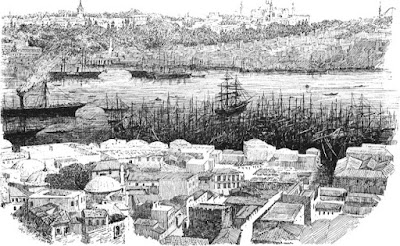
At last, both City of Countless Names and North of the Golden Horn are done (for now)! The revision of City of Countless has added a little text, greatly improved the layout, corrected some errors, hyperlinked the contents, and sharped the illustrations. I'm very proud to have this terrific little gazetteer look as good as my last project. They really belong together now.
You can find the new revised City of Countless Names and the newly released North of the Golden Horn on the Blog's Resource Page here, or click the links below:
City of Countless Names PDF

North of the Golden Horn

These two PDfs are the first half of my guide to Constantinople for Victoriana. I plan to take a bit of a break from the city of the sultans and get back to London for a bit. It's been fun and I'm charged for more, but I'm lacking certain perspectives on the city.  Until then, we'll be looking at some more obviously Victorian content.

Friday, August 31, 2018

City of Countless Names- Revision


After seeing how well the layout of North of the Golden Horn came out, I decided to take a couple of weeks and update the PDF of City of Countless Names to bring it up to that same level of quality and style. I’m swapping some illustrations for better replacements, adding a little bit more information here and there, and hyperlinking the chapters.
I need to add two more illustrations before I proofread the entire document to make sure I did not accidentally delete something while adjusting the layout. Next week I’ll rerelease City of Countless Names, and the following week  we'll continue with new weekly content for the Victoriana RPG.


Friday, August 24, 2018

City of Countless Names- North of the Golden Horn


HERE IT IS! The PDF of North of the Golden Horn is now available to download for free. North of the Golden Horn is the second installment of City of Countless Names, a guide to 1855’s Constantinople for the Victoriana RPG. Featuring 37 pages of historical fact mixed with Victoriana’s fantastic setting, North of the Golden Horn details the 10 neighborhoods, quarters, and suburbs of the Pera-Galata section of Constantinople, gloriously brought to life with 28 illustrations. Each section contains the period details, fascinating locations, local color, and plot-hooks to bring Constantinople to your Campaign.
I am so proud of this document. The quality of the layout and design has advanced so far from the last book, I am going to go back and bring City of Countless Names up to this standard. Each section is now hyperlinked for ease of use, the style is cleaner and more evocative of Victorian travelogues, and the illustrations and portraits really pull the setting to reality. I am so excited to release North of the Golden Horn!

 And you can always find all my other Victoriana PDFs here:
Resources

Friday, August 17, 2018

City of Countless Names- Illustrations 2


In one week, you will be able to download North of the Golden Horn, bringing Pera-Galata to your own Victoriana campaigns. This week we’re finishing up the last minute details and adding a brand new feature: Random Encounter tables. Thirty-six entries ready to pull players into life on the streets of Pera-Galata, featuring NPC descriptions, interesting choices, plot hooks, and danger.
During its revision and rewriting stage, North of the Golden Shore has blossomed into so much more than I thought it would be. I can’t wait to share the final document with you. For this week, you will have to be content with more of the illustrations gracing its pages.


Until I upload the PDF, the work on the illustrations does not stop. I already had a perfectly good illustration of the Orta Keui Mosque edited and inserted in the document. While looking for something else, I stumbled over this detailed and elegant picture and replaced its inferior predecessor.


Beyond the challenge of just finding pictures of the locations described in this book, I also had to make sure the pictures showed the buildings as they appeared at the time. The iconic Tophane Fountain has been renovated a number of times over the years with a number of major architectural changes to its roof. This picture showed the fountain’s original roof with overhanging eaves and a small dome. After a little editing and some close examination of reference photos, Tophane fountain sits as it did in 1855.


This week, I realized I had neglected Pera’s European high society in the illustrations. Fortunately, I quickly found an appropriate picture with a few persons ready to be transformed into elves and a halfling. The halfling took the most work as I had to put him behind the woman in the foreground, shrink and position him to proper halfling stature, and replace all the background that he once covered. I think it worked out well.

Friday, August 10, 2018

City of Countless Names- Illustrations


The work on the fine finishing details for North of the Golden Horn continues. Right now we are proofreading, formatting, writing some introductory text, and finalizing the illustrations. Much like City of Countless Names, North of the Golden Shore will be fully illustrated with over 25 period sketches, landscapes, and street scenes gloriously spread over its 35 pages. I give my undying thanks to the British Library and Internet Archive’s Flickr streams for providing the original artworks.
Here are a few of the finished illustrations:


 Some pieces are pretty much perfect. They just need a little clean-up and some cropping. This illustration of Dolmabagtche Palace captures the grandeur of Beshiktash. Some contrast and saturation adjustment and it’s ready.


 At its heart, this whole project strives to bring life in Constantinople to the gaming table. I mixed in an interesting assortment of street scenes showing common everyday occurrences and people, but whenever I can I try to give them a subtle Victoriana twist. For example, in this picture, I shrunk down the farmer and made him a little stockier to indicate his dwarven heritage. Simple and subtle.


In contrast, I had to do a fair bit of dancing in my editing program to get that ogre behind the soldiers. I am very proud of how well he blends in, and if you look closely, the slim soldier in the foreground has elf ears. Wherever I could, I pulled elements from Victoriana’s setting into the illustrations, because the words on the page give the Gamemaster facts and rules, but the art is where the style and tone most effectively shine through.

Friday, August 3, 2018

City of Countless Names- Tophane p3

Okay, this is the last post exploring the incredible sights (and often smells) of Constantinople's Northern Shore.  For the next couple of week, I'll be assembling these posts together into a fully illustrated PDf. You'll get some glimpses of the art next Friday.

Tophane Fountain
Constantly teeming with hamals, vendors, commuters, and sailors, the streets of Tophane are the busiest arteries in Pera-Galata. In 1732, Sultan Mahmud I commissioned the building of Tophane Fountain, one of the largest and most beautiful fountain kiosks in Constantinople, to provide drinking water for the passing crowds. He may have committed this charitable deed to curry favor with his subjects after having over 7,000 members of a revolt executed.
The four ornate walls of the fountain kiosk form a large white marble square twenty-six feet high. Each identical side possesses an inset arch with a water-dispensing spigot above a trough surrounded by arabesque reliefs of trees, roses, and calligraphy in gold plate. Despite possessing a dome with overhanging eaves in its original construction, renovations in 1837 crowned the fountain kiosk with a veranda surrounded by a protective balustrade matching the dimensions of its walls. Tall trees growing up around the fountain shade the many thirsty visitors to the fountain from the sun’s rays.
The freely given water draws people from every nation and class to fountain square. Livestock slake their thirst at the water troughs. Tired laborers wash under the cistern’s cool stream. Servants and sons fill their buckets with water for household uses. Nithamiyeen faithful perform their ritual washings kneeling at the fountain’s troughs before praying at the nearby Kilic Ali Pasha mosque. Peddlers of vegetables and fruits gather their stalls in the square around the fountain.

Nusretiye Mosque and Clock Tower
On the far eastern end of the fountain square, the sharply pointed twin minarets and dome of Nusretiye Mosque rise over the east side of Tophane. In 1823, construction began to rebuild the mosque attached to the Tophane barracks which had been damaged in a fire. Work completed in 1826, only a few months after the Sultan Mahmud II defeated the Janissaries in “the Auspicious Incident”. The Sultan commemorated his recent eradication of the Janissary class by naming his new mosque “Nusretiye” meaning “Divine Victory”. To this day, Nusretiye remains a symbol of Tanzimat reforms.
Nusretiye is an unusually large mosque and its grand baroque architecture makes it even more distinctive. High granite walls with rectangular windows enclose the building. Short turrets grow around the mosque’s majestic 108-foot tall dome. A raised foundation lifts the mosque above the receding ground of the Bosporus shore and brings its minarets closer to the sky. In the vast, square prayer hall, four arches growing from the corners of the room support the magnificent ceiling elaborately ornamented with gold and shades of blue.
To the east of the mosque stands a rare sight in the Ottoman Empire, Nusretiye Clock Tower. Turks prefer to keep the time of day by the muezzin’s call to prayer than the loud ringing of bells. Sultan Abdulmejid modernized punctuality in Tophane by building a clock tower for his father’s mosque in 1848.  The 50-foot tower of extravagant neoclassical style offends traditional Ottomans. The chimes remain unused, but the tower’s silence is not enough to keep the peace. Only the monogram of the sultan sealed above the tower’s doorway stops vandals and zealots from damaging the delicate mechanisms, stopping the tower’s four clock faces for good.